by Tabby Biddle
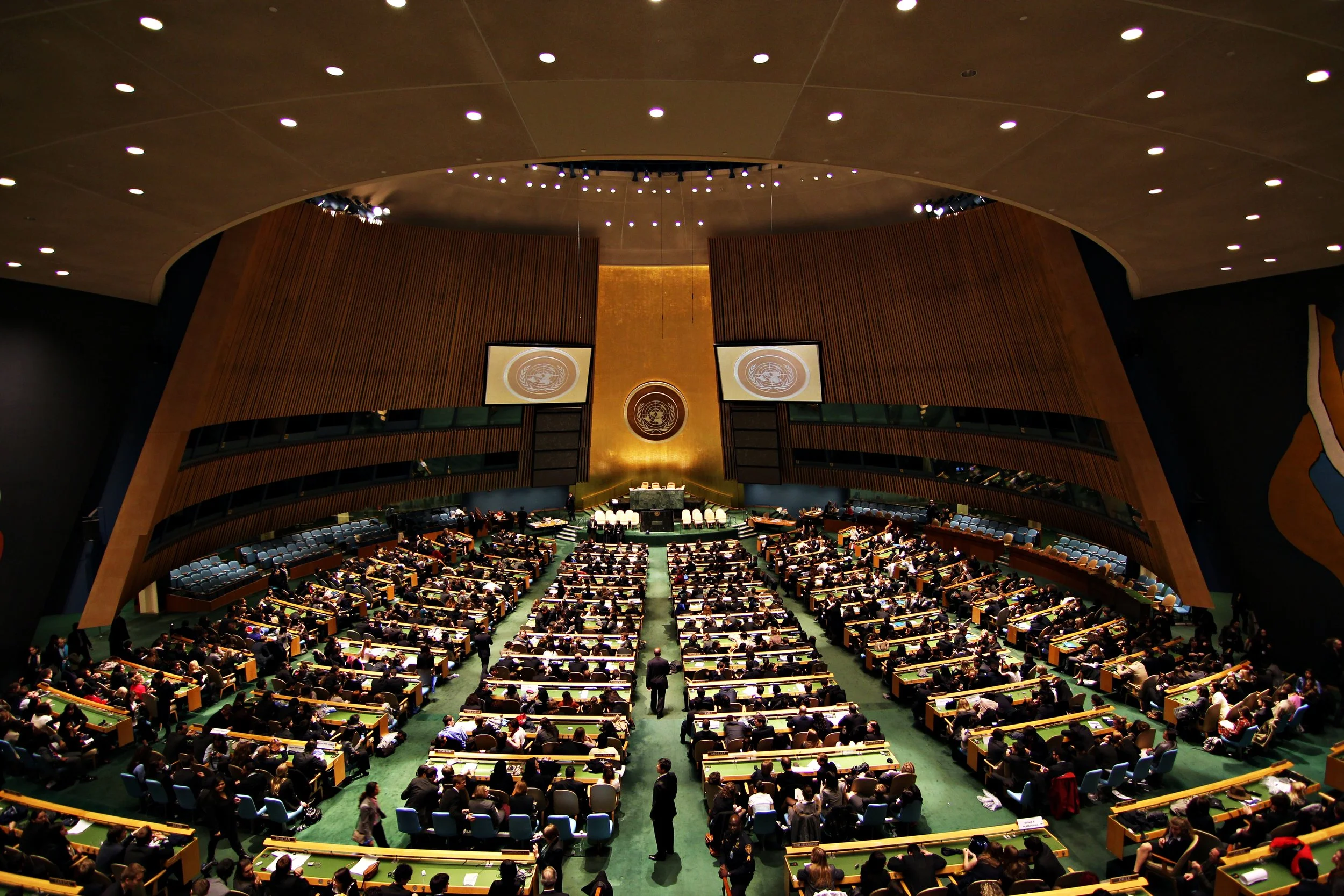
Photo Credit: Basil D Soufi, Wikimedia Commons.
I was sitting in a packed United Nations conference hall in New York City, surrounded by women from every region of the world — activists, diplomats, organizers, ministers — all gathered for the 61st session of the UN Commission on the Status of Women.
It was nearly a decade ago, March 2017. The opening session was about to begin.
The Chair of the Commission took the podium. To my surprise, it was a man. Mr. Antonio de Aguiar Patriota of Brazil.
After he spoke, another man came to the podium, the Secretary-General of the United Nations, António Guterres. Then another man. And then another.
Thirty-five minutes passed and a woman’s voice had not yet been heard in the room.
My blood was boiling. This was the Commission on the Status of Women.
That moment crystallized something for me. The United Nations talks a lot about gender equality, stating it as one of its priorities and declaring that female empowerment would unleash potential to chart a new global future, but it has yet to embody it within its own ranks, and especially at the highest levels of power.
Nearly 80 years after its founding, the United Nations has never appointed a woman as Secretary-General.
And here we are again.
As the race begins for the next UN Secretary-General, more than 100 member states have publicly encouraged the nomination of a woman. Yet many of those statements include a familiar preface: a qualified woman.
The phrasing may seem harmless, but it’s not.
As Tamao Chika and Jennifer Hernandez documented in their recent analysis in PassBlue, women who ran for the Secretary-General position in 2016 were as experienced — and in many cases more experienced — than their male counterparts.
Their research, conducted in partnership with NYU’s Center for Global Affairs and the Global Network of Women Peacebuilders, examined years of leadership experience across government, international organizations, civil society, and the private sector. The women candidates averaged virtually identical government leadership experience as the men and brought significantly more experience in international institutions and civil society.
In other words, the data does not show a pipeline problem. It shows a power problem — a structural bias against women exercising power.
When that bias shapes the highest office in global diplomacy, it shapes the direction of the institution itself.
And yet the UN’s mission to preserve peace, protect human rights, deliver humanitarian aid, promote sustainable development, and uphold international law cannot be achieved without the leadership of women.
Women are half of the global population. According to UN data, they are disproportionately impacted by war, displacement, poverty, and climate disruption. And still, women remain structurally excluded from leadership at the highest tables of global power.
“We stand for a powerful truth: women’s equality works for the world,” said UN Secretary-General António Guterres as he stood at the podium in that room full of female diplomats, ministers, activists and organizers from around the world. “Hold us to our promises. Do not let us off the hook.”
If there were ever a moment to hold the UN to its promises and not let them off the hook, it is now. And if there were ever a moment that required a different model of leadership, it is now.
Critics argue that the United Nations is losing relevance, pointing to its inability to prevent major conflicts, its bureaucratic inefficiencies, and instances of corruption and mismanagement.
Those critiques are valid.
And yet, the UN remains one of the only global forums where nations can gather — imperfectly, but peacefully — to negotiate, to establish international law, and to coordinate emergency responses to pandemics, climate change, terrorism, and humanitarian crises.
Despite its flaws, the UN continues to foster social and economic development, promote education, improve healthcare access, and raise living standards in communities around the world.
The UN still matters, and precisely because the UN matters, its leadership matters.
Historically, international power and leadership has been exercised through dominance, geopolitical maneuvering, and negotiation shaped primarily by national interests, especially those of the most powerful member states.
As democracy is eroding, authoritarianism is on the rise, and global crises multiply, we are experiencing the limits of this traditional “power over” leadership model that has been prevalent at the UN, and other international institutions.
What the UN needs now is a new model of leadership, one based less on “power over” and more on “power with.”
It has been well-documented that women’s leadership often emphasizes empathy, collaboration, consensus-building, inclusivity, long-term vision, and social responsibility, creating solutions that prioritize the well-being of all, not just a few.
This leadership style is critical in building equitable systems where all voices, particularly those of marginalized groups, are heard and valued, and where long-term societal stability is prioritized.
For example, when women are meaningfully included in peace processes, they expand the frame of negotiation. Instead of asking, How do we win? the conversation shifts toward, How do we create more sustainable societal stability?
Instead of securing short-term advantage, the focus moves toward securing long-term stability, expanding the agenda to include issues like community security, economic development, and humanitarian aid.
We have seen this repeatedly.
In Northern Ireland, women from opposing political and religious communities formed the Northern Ireland Women’s Coalition and secured seats at the peace table, helping shape the Good Friday Agreement with provisions on human rights, reconciliation, and integrated education.
In Liberia, women organized across religious and ethnic lines — most famously through the Women of Liberia Mass Action for Peace movement — applying sustained civic pressure that helped bring warring factions to negotiation and ultimately contributed to the end of a brutal civil war. Liberia later elected Africa’s first female head of state. Today, more than 20 years later, Liberia is currently in a state of stable peace.
In Rwanda, women played a central role in post-genocide reconstruction, and today the country has one of the highest percentages of women in parliament in the world.
Research from the United Nations shows that when women are included in peace negotiations, agreements are more durable, with a 35% higher probability of lasting at least 15 years.
And yet, despite this evidence, women remain dramatically underrepresented in UN-led peace processes.
Why is this?
Many women leaders have had to navigate systems not built for them. In doing so, they have cultivated capacities the world urgently needs: the ability to build alliances across difference, to listen before reacting, to hold complexity without collapsing into division, and to think beyond short-term wins toward generational impact.
This is what I call feminine leadership.
Feminine leadership does not mean soft leadership, which some people will say to dismiss it.
It means being strong, without dominating. It means having conviction, without dehumanizing others. It means holding people accountable, without humiliating them.
Feminine leadership understands that security doesn’t come from just building a bigger military. It comes from treating people with kindness, respect, and dignity. It recognizes that humanitarian response, climate policy, and peacekeeping are not separate silos, but interconnected human realities.
Feminine leadership integrates moral courage with relational intelligence and asks not only how to resolve a conflict today, but how to prevent it for future generations.
I believe this is the model of leadership the United Nations was created to embody, but has yet to fulfill.
Some will argue that gender alone does not guarantee better leadership. They are correct. A woman can govern within a “power over” framework just as easily as a man.
This is not the kind of woman leader I am calling for.
I am calling for a leader grounded in feminine values — relational intelligence, moral courage, and a commitment to shared power — values available to all genders, but too often absent from the highest levels of global authority.
The UN does not need a representational woman as Secretary-General. It needs a transformational one.
While representation is important, this is not just about representation. It is about the future of leadership and our collective future. The world does not need another caretaker of the status quo. It needs an evolutionary leader.
It needs a leader who understands human rights not as abstract doctrine but as a lived reality. A leader who has navigated entrenched power and refused to be diminished by it. A leader who can sit across from the permanent five members of the Security Council, defend the UN Charter with clarity and conviction, and still maintain the diplomatic alliances required to move the UN agenda forward.
It is said that the Secretary-General must be “acceptable” to all five permanent members of the Security Council (China, France, Russia, the UK and the US). But acceptable at what cost?
If the selection process rewards those who are unwilling to challenge structural inequities embedded within the system, we will continue to reproduce the very dynamics that have limited the UN’s effectiveness.
I am not purporting that choosing a woman will automatically solve all the UN’s challenges. But choosing another man after nearly eight decades of uninterrupted male leadership would put the credibility and relevance of the United Nations further in the balance.
The legitimacy of the United Nations rests not only on its charters and declarations, but on whether it embodies the principles it asks the world to uphold. We are talking about an institution that calls on nations to advance gender equality while never elevating a woman to its highest office.
At a time when trust in international institutions is eroding, the United Nations cannot afford another contradiction between its rhetoric and its reality.
The question is no longer whether qualified women exist. They do.
The question is whether the United Nations is ready to evolve and align its leadership with its stated goals to maintain international peace and security, protect human rights, deliver humanitarian aid, promote sustainable development, and uphold international law.
Nearly a decade ago, in that packed UN conference hall in New York City where I sat, a woman finally took the podium after 35 minutes of male voices. As Executive Director of UN Women Phumzile Mlambo-Ngcuka walked up to the podium and spoke, the energy in the room shifted. The room awakened. Applause and cheers filled the hall. It felt as though the Commission on the Status of Women had truly begun.
It cannot be denied that representation changes the atmosphere of a room. Nor can it be denied that leadership changes the direction of an institution.
If the UN can’t embody gender equality at its highest levels of leadership, how can it credibly ask the world to do so?
“Hold us to our promises,” UN Secretary-General António Guterres said that morning. “Don’t let us off the hook.”
Very well. This is that moment. The time for a female Secretary-General has arrived.
Tabby Biddle, M.S. Ed., is a two-time United Nations Foundation Press Fellow and has served as a delegate to multiple sessions of the UN Commission on the Status of Women. Learn more at tabbybiddle.com.